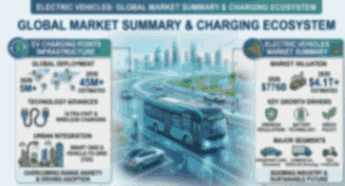
According to market intelligence reports by Roots Analysis, the global electric vehicle (EV) ecosystem is experiencing massive expansion across various sub-sectors, including overall vehicle manufacturing, charging infrastructure, traction motors, and vehicle-to-grid (V2G) technology.
Global Electric Vehicles Market Overview
Market Valuation: Valued at USD 776 billion, the global EV market is projected to reach USD 1,530 billion by 2030 and USD 4,089 billion by 2035, expanding at a compound annual growth rate (CAGR) of 20.27%.
Propulsion & Battery Trends:
- Battery Electric Vehicles (BEVs) lead the market share due to zero tailpipe emissions, aggressive OEM investments, and continuous improvements in battery range.
Lithium-ion batteries dominate the market share owing to high energy density and rapid recharge capabilities, though solid-state batteries are emerging as a high-potential future alternative due to superior safety.
Application: Electric cars dominate market applications in North America and Europe, while small hybrid cars and two-wheelers are surging in developing economies to curb urban congestion.
Electric Vehicle Charging Market
Market Valuation: The global EV charging market reached USD 52.0 billion, heading toward USD 410.9 billion by 2040 at a CAGR of 15.91%.
Segment Insights:
Access Type: Residential/private charging accounts for the largest share (38% in 2026), while fleet/depot charging is growing rapidly at a 20.4% CAGR.
Vehicle Type: Passenger cars occupy the majority share (65%), but heavy-duty electric trucks represent the fastest-scaling demand vector (23.4% CAGR) driven by megawatt freight charging.
Connectors: The Combined Charging System (CCS) holds a prominent baseline share (38%), while GB/T fast charging is expanding aggressively backed by high-power Chinese infrastructure.
Geographical Hub: Asia-Pacific leads the global market with a 45% share, heavily anchored by China's dense EV adoption and domestic manufacturing scale.
Electric Vehicle Traction Motor Market
Market Valuation: Valued at USD 11.3 billion, the traction motor market is scaling to USD 17.12 billion, reaching USD 316.84 billion by 2035 at a rapid CAGR of 33.88%.
Key Segments:
Motor Type: Permanent Magnet Synchronous Motors (PMSMs) capture the lion's share (~67.98%) due to high overload capability, high torque at low speeds, and compact efficiency.
Power Output: Motors rated under 100 kW dominate (~64.6% share) due to the heavy global uptake of electric scooters, mopeds, and compact urban city cars.
Vehicle-to-Grid (V2G) Market Insights
Market Valuation: The global V2G market is projected to soar from USD 4.28 billion to USD 34.84 billion by 2035 at a CAGR of 23.32%.
Core Technology Drivers:
Bidirectional charging dominates technology type (78% revenue share), allowing cars to supply stored energy back to public grids for load balancing.
AC chargers hold the largest charger type share (~69%) because of their wide residential and public layout integration.
Hardware components take the majority share (67.78%) of V2G systems, while V2G software solutions are projected to experience the fastest growth (approx. 24.78% CAGR).
Niche EV Sectors (e.g., Marine Electric Vehicles
The marine electric vehicle market is growing from USD 10.22 billion in 2025 to USD 36.08 billion by 2035 (CAGR of 13.44%), heavily catalyzed by stricter environmental policies and short-range leisure/tourist surface ships (<50 km routes).
Conclusion
The global electric vehicle ecosystem is transitioning past its early adoption phase into a mature, multi-trillion-dollar industrial paradigm. Driven by supportive government regulations, aggressive net-zero carbon targets, and falling component costs, the market is expanding at a robust double-digit CAGR (surpassing 20%). While Battery Electric Vehicles (BEVs) and Lithium-ion power units anchor current baseline revenues, ongoing cross-sector innovations in smart charging, high-performance insulation, and compact powertrain design ensure that growth is deeply distributed across the entire supply chain—from raw material extraction and component engineering to grid integration.
Future Trends (2026–2035)
Solid-State Battery Commercialization: The market is poised to shift incrementally away from conventional liquid lithium-ion setups toward solid-state alternatives, promising higher energy densities, minimized fire hazards, and shorter charging times.
Mainstream Integration of Vehicle-to-Grid (V2G) Tech: Bidirectional charging will evolve from experimental pilots into standard grid utilities, allowing parked electric fleets to function as active decentralized power banks for load balancing and frequency regulation.
Megawatt Charging for Heavy-Duty Freight: While residential and light passenger connectors (like CCS and AC blocks) dominate today, the next decade will witness accelerated infrastructure buildouts for heavy electric trucks using high-power megawatt systems.
Advanced Thermal and Lightweight Insulation: As fast-charging speeds increase, managing extreme thermal loads becomes vital. Future designs will heavily favor advanced carbon-fiber composites and specialized thermal interface materials to safeguard pack lifecycles.
Regional Shifts & Developing Hubs: While the Asia-Pacific region (anchored by China) maintains dominant manufacturing and volume scale, North America and Europe are projected to experience some of the steepest acceleration curves via local supply-chain incentives and localized giga-factory expansions.
https://www.rootsanalysis.com/electric-vehicles-market
|
|